
Metabolism and nutrition
How certain variants may relate to nutrient metabolism and individual responses to components of food.
Genetic study
One sample. Information you can revisit throughout life.
Your DNA contains millions of variants. Some may influence your predisposition to certain diseases, your response to particular nutrients, your metabolism or other health-related characteristics.
Our genetic study based on polygenic risk scores turns some of this information into data that may help you make more personalised prevention decisions.
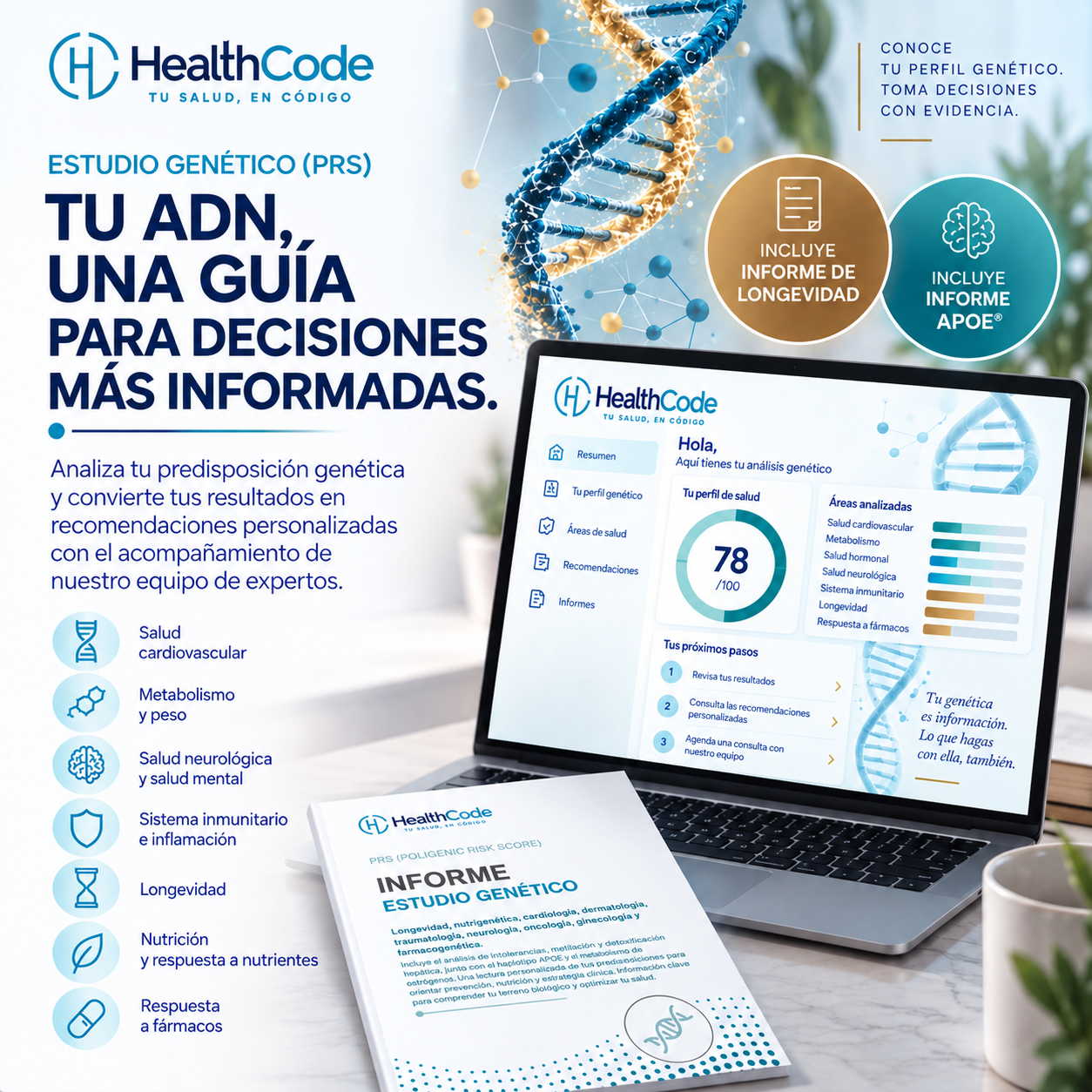
Visual example created with simulated data. It does not represent a real patient or the expected results of the service.
“This is more than a curiosity test. It is information I can revisit for years.”
01 — The study
Health does not depend on a single gene.
Most complex conditions do not depend on a single genetic variant.
Hundreds or thousands of small differences in our DNA may be involved, alongside environment, lifestyle and other factors.
Polygenic risk scores combine the effects of many of these variants to estimate a particular genetic predisposition.
This shifts the focus from one isolated piece to a broader part of the genetic picture.
02 — What it can offer
The study analyses different areas related to:
How certain variants may relate to nutrient metabolism and individual responses to components of food.
Genetic predispositions related to different cardiovascular risk factors.
Genetic information related to inflammatory processes and the body's response.
Certain predispositions related to hormonal metabolism and reproductive health.
Variants and scores related to different aspects of neurological health.
Genetic information related to certain characteristics of performance and exercise response.
Variants related to processes associated with ageing and oxidative stress.
How certain variants may influence response to or metabolism of some medications.
Your genetics is one part of the equation.
That is why the value of the study is not simply receiving a percentage or score.
It lies in interpreting that information within each person's context.
03 — Your health equation
Genetics + environment + habits + age + clinical context = how your health is expressed
04 — Why consider it
It may help you explore questions such as:
Which areas of my health deserve particular attention?
Is there a genetic predisposition I should know about?
What aspects of my diet could I personalise?
What risks should I watch over the long term?
Could any genetic information be useful to my doctor?
Which lifestyle choices make the most sense for my profile?
05 — The Health Code difference
Genetic results can be complex.
That is why the study includes personalised professional interpretation.
We review your results and explain them in accessible language, focusing on what may be relevant to you.
Data → interpretation → priorities → action.
 VISUAL EXAMPLE · SIMULATED DATA
Visual example created with simulated data. It does not represent a real patient or the expected results of the service.
Genetic information
Your DNA remains essentially stable throughout your life.
This means the genetic information you obtain today may remain relevant at different stages of your life.
As scientific research advances, our understanding of genetics and health may continue to evolve.
07 — Process
Saliva sample. Approximate turnaround: 8 weeks.
Purchase the study
Saliva sample.
Prepaid envelope included in the kit.
The sample is sent to a partner laboratory.
Folder containing all reports.
Personalised professional interpretation session included.
08 — Results
Digital document, organised information and clear reading priorities.
Visual example created with simulated data. It does not represent a real patient or the expected results of the service.
09 — What's included
10 — Important information
The polygenic risk score study provides information about genetic predispositions for preventive and informational purposes. It is not, by itself, a medical diagnosis and does not determine whether someone will develop a disease. Results must be interpreted within the individual's clinical context.
11 — Genetic study
Includes a personalised professional interpretation session.
12 — Frequently asked questions
No. Genetics may inform about predispositions, but it does not, on its own, determine what will happen. Results should be interpreted alongside other factors.
13 — 15 min Evaluation
Tell us what you are looking for, ask your first questions and explore a possible starting point for your situation. Free and with no obligation.